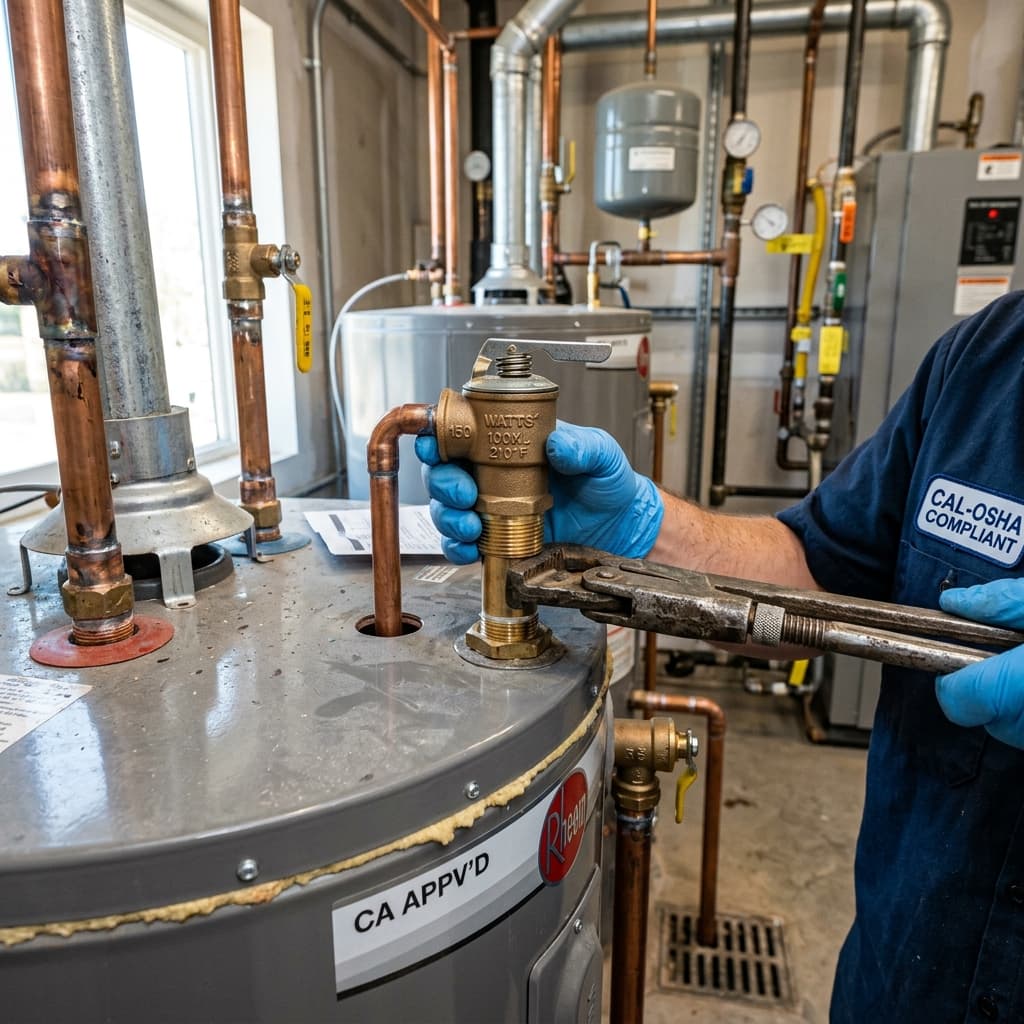

# Water Heater Sizing, Installation, and Temperature/Pressure Relief Valve Requirements for C-36 Exam Success
Water heater installation requirements california plumbers must know form a critical component of the C-36 plumbing certification exam. Whether you're sizing a residential tank for a family of four or calculating relief valve capacity for a commercial application, understanding water heater sizing calculations and temperature pressure relief valve cpc compliance is essential to passing Part 3 of the exam.
This comprehensive guide walks you through every critical aspect of water heater sizing, installation standards, and safety requirements you'll encounter on test day.
Understanding Water Heater Capacity and Sizing Fundamentals
Water heater capacity sizing is not arbitrary—it's based on occupancy demand and recovery capabilities. The California Plumbing Code (CPC) establishes specific standards for determining appropriate tank size and recovery rates.
What Determines Water Heater Size?
Three primary factors drive water heater capacity decisions:
- Peak Hour Demand (PHD) - The maximum hot water gallons needed during the busiest hour
- Recovery Rate - Gallons per hour the heater can heat from cold to setpoint temperature
- Storage Capacity - Tank volume available for hot water reserve
If your peak hour demand exceeds the recovery rate, you need sufficient tank storage to make up the difference.
CPC Section 308 Installation Standards
CPC Section 308 establishes the baseline for all water heater installations in California. Key requirements include:- Section 308.1 - All water heaters must be installed per manufacturer specifications and local code requirements
- Section 308.3 - Demand water heaters must be sized per Section 303.3
- Section 308.4 - Temperature and pressure relief valves are mandatory on all closed systems
- Section 308.6 - Discharge piping must be properly sized and terminated
Water Heater Sizing Calculations for the C-36 Exam
The C-36 exam will present scenarios requiring you to calculate the proper water heater capacity. Let's break down the calculation methods you need to master.
Method 1: Peak Hour Demand Calculation
Peak Hour Demand is calculated based on occupancy type:
Residential (single-family):- 1-2 occupants: 20 gallons per person
- 3-4 occupants: 12-15 gallons per person
- 5+ occupants: 10-12 gallons per person
- PHD = 4 occupants × 14 gallons = 56 gallons
- Hotels/motels: 10-12 gallons per room
- Hospitals: 25-30 gallons per bed
- Schools: 3-4 gallons per student
- Laundries: 35-50 gallons per machine
Method 2: BTU Demand and Recovery Rate Formula
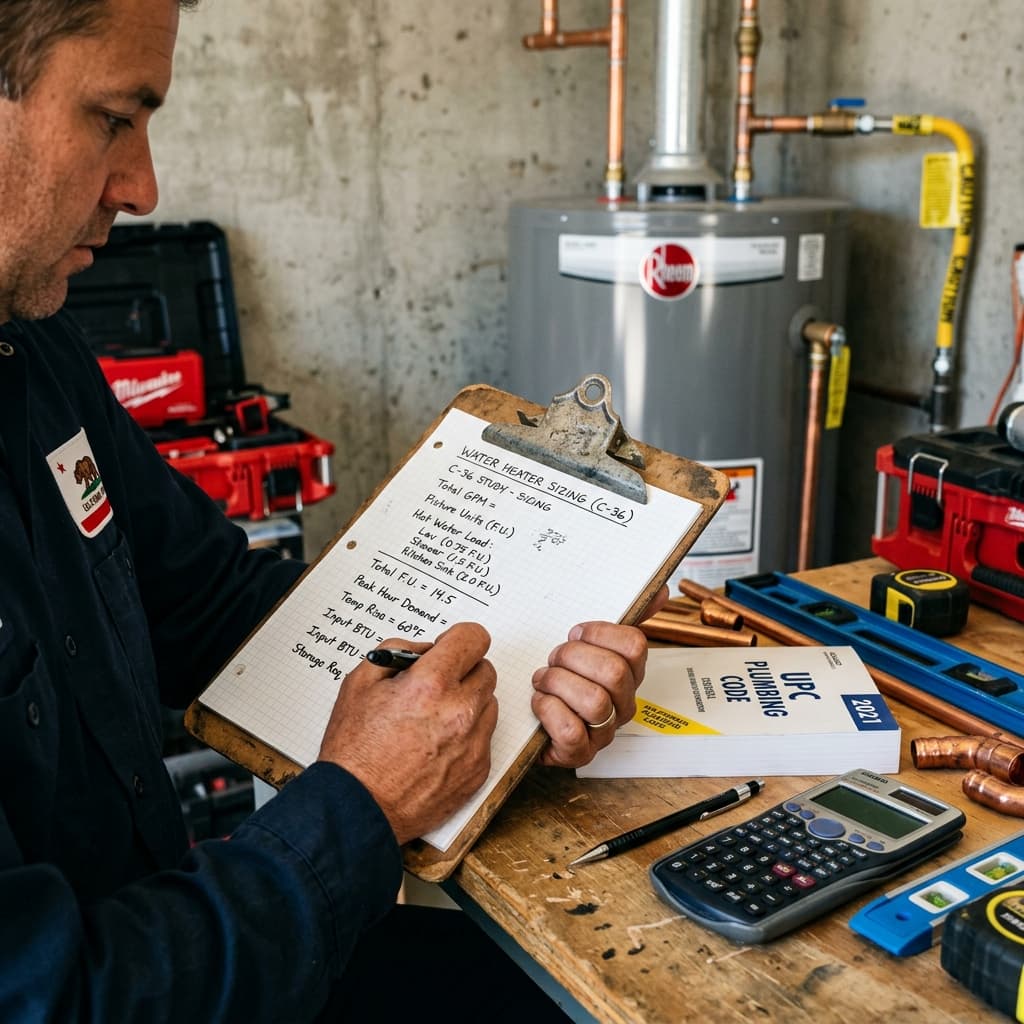
When dealing with recovery rates, use this essential formula:
BTU Required = GPM × Temperature Rise × 500 Where:- GPM = Gallons per minute needed
- Temperature Rise = Desired outlet temp minus incoming temp (typically 70°F rise from 55°F supply to 120°F delivery)
- 500 = BTU conversion constant for water
- BTU Required = 3 GPM × 65°F rise × 500 = 97,500 BTU/hour
Method 3: Tank Size with Recovery Rate Factor
When recovery rate is known:
Required Tank = PHD - (Recovery Rate × Hours Available) Example Scenario (typical C-36 exam question):- Peak hour demand: 80 gallons
- Recovery rate: 40 GPH
- Calculation: 80 - (40 × 1) = 40-gallon minimum tank
Temperature and Pressure Relief Valve Requirements
The temperature pressure relief valve (T&P valve) is the most critical safety component on any water heater. The C-36 exam heavily emphasizes T&P valve sizing, location, and installation.
CPC Section 608 Relief Valve Requirements
CPC Section 608 governs relief valve requirements: Section 608.1 requires:- All hot water systems over 120°F must have automatic relief protection
- Relief valves must operate at or below the system design pressure
- Multiple relief devices must be installed on systems exceeding 120 gallons
- Relief valve discharge must be piped to a safe, visible location
- No shut-off valves between heater and relief valve (critical!)
- Discharge pipes must drain to floor drain or indirect waste
Sizing the Temperature/Pressure Relief Valve
T&P valve sizing is based on the water heater's BTU input rating:
Relief Valve Capacity Required (GPH) = BTU Input ÷ (Temperature Rise × 500) Standard T&P Valve Capacities:- Residential (30-50 gal tank): 20-30 GPH rating
- Standard commercial: 50-100 GPH rating
- Large commercial systems: 150+ GPH rating
Critical Installation Rules for T&P Valves
These requirements appear frequently on the exam:
- No Shut-off Valve Between Heater and T&P Valve - CPC Section 608.2 prohibits isolation. This is a violation frequently tested.
- Discharge Pipe Sizing - The discharge pipe must not be smaller than the outlet connection (typically ½ inch for residential):
- Discharge Termination - Must terminate:
- Pressure Setting - T&P valve must be set at or below the system design pressure, typically 150 PSI for residential systems
Calculating Discharge Pipe Size
When sizing the discharge piping from T&P valve:
Pipe Diameter = √(GPH ÷ 100) Example:- 50 GPH relief valve
- √(50 ÷ 100) = √0.5 = 0.71 inches
- Minimum ¾-inch discharge pipe required
Water Heater Installation Location Requirements
CPC Section 308 addresses specific installation considerations that appear on the C-36 exam:
Temperature Regulation
- All heaters must maintain supply temperature between 110-120°F for scald prevention
- Thermostatic mixing valves required when high-temperature storage exceeds 140°F
- Mixing valves must have checkstops and manual shutoff per CPC Section 304
Seismic Restraint Requirements
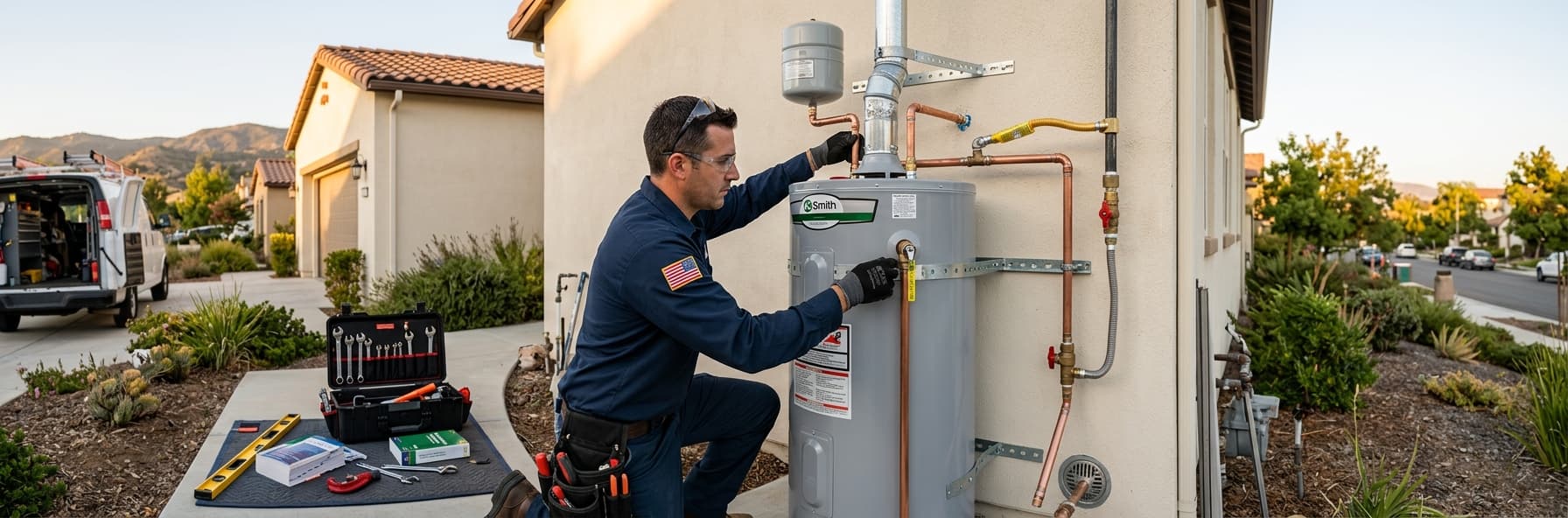
California's seismic code requires:- All water heaters over 20 gallons must be strapped
- Top strap within 12-18 inches of highest point
- Bottom strap within 12-18 inches of base
- Maximum strap spacing: 48 inches
Ventilation Requirements
- Gas water heaters require adequate air supply (10 CFM per 100,000 BTU minimum)
- Combustion air ducts must be sized per CPC Chapter 12
- Electric heaters have no ventilation requirement
Common C-36 Exam Scenarios and Solutions
Scenario 1: Residential Single-Family Home Sizing
Problem: A 3-bedroom home with 3.5 occupants needs a water heater. Peak hour demand is estimated at 45 gallons. Available recovery rate is 35 GPH. What minimum tank size is needed? Solution:- Calculate shortfall: 45 gallons (demand) - 35 (recovery) = 10 gallons
- Required tank = 10 gallons minimum
- Answer: 30-40 gallon tank provides adequate reserve
Scenario 2: Relief Valve Sizing for Commercial Application
Problem: A 100-gallon commercial water heater with 150,000 BTU/hour input is installed. What minimum relief valve capacity is required? Temperature rise is 80°F. Solution:- Relief capacity = 150,000 BTU ÷ (80°F × 500)
- = 150,000 ÷ 40,000
- = 3.75 GPM or approximately 225 GPH
- Answer: Minimum 30-GPM (1800 GPH) relief valve required
Scenario 3: Installation Code Violations
Problem: Identify the code violation: A water heater has a shut-off valve installed between the heater outlet and the T&P valve relief inlet. Solution: This violates CPC Section 608.2, which prohibits isolation valves between the heater and relief valve. This is unsafe because:- Operator could accidentally close valve
- Pressure builds with no relief pathway
- Tank rupture hazard exists
Study Tips for Water Heater Questions on the C-36 Exam
- Memorize Standard Capacities - Know that residential tanks range 30-80 gallons and recovery rates typically 30-50 GPH
- Remember the 500 Constant - The BTU formula always uses 500 as the conversion factor: GPM × °F Rise × 500
- T&P Valve Rules are Absolute - No shut-off valves between heater and relief valve is a non-negotiable code requirement
- Check Your Discharge Pipe - Relief valve discharge must be visible, unobstructed, and properly sized
- Apply the 6-Inch Rule - Discharge termination must be within 6 inches of floor to prevent scalding hazards
Conclusion
Mastering water heater installation requirements california plumbers must follow—including sizing calculations and temperature pressure relief valve cpc standards—is essential for C-36 exam success. By understanding the fundamental formulas, CPC requirements, and common scenarios, you'll approach Part 3 with confidence.
Practice calculations repeatedly until the formulas become second nature. Remember that water heater safety isn't optional—it's the foundation of professional plumbing practice in California.
Ready to test your knowledge? Review the exam scenarios above and create your own practice problems using local building specifications.