
# Water Heater Capacity Sizing and Temperature/Pressure Relief Valve Requirements for C-36 Compliance
Water heater installation requirements California are fundamental to every plumber's skill set, whether you're installing a residential tankless system or a commercial storage tank. As you prepare for your C-36 plumbing license exam, understanding water heater sizing calculations and temperature pressure relief valve requirements will directly impact your success on Part 2: Water Supply and Distribution. This comprehensive guide breaks down everything you need to know about CPC Section 422 compliance.
Understanding CPC Section 422: Water Heater Requirements
California Plumbing Code Section 422 establishes the mandatory standards for all water heater installations throughout the state. This section forms the backbone of water heater installation requirements California and is essential knowledge for anyone pursuing a C-36 plumbing license. CPC Section 422 covers:- Water heater capacity sizing calculations
- Temperature and pressure relief valve installation and sizing
- Venting and combustion air requirements
- Expansion tank requirements for closed water supply systems
- Materials and construction standards
- Energy efficiency requirements
Why Proper Sizing Matters
Undersized water heaters create insufficient hot water for peak demand periods, leading to customer complaints and potential callbacks. Oversized units waste energy and increase installation costs unnecessarily. The California Plumbing Code requires that water heater capacity be determined using established calculation methods based on fixture units and peak hour demand.
Water Heater Capacity Calculations
The Fixture Unit Method
The fixture unit method is the primary approach for sizing water heaters under CPC Section 422. This method accounts for the simultaneous use of multiple fixtures and establishes a demand load in BTU per hour.
Step 1: Identify all hot water fixtures Count every fixture that requires hot water:- Bathrooms: lavatory faucets, showers, bathtubs
- Kitchen: sink faucets
- Laundry: washing machines
- Dishwashers
- Hose bibbs
- Other fixtures
Each fixture has a standard fixture unit value per CPC Table 424.2:
| Fixture Type | Fixture Units | |---|---| | Bathroom group (toilet, lavatory, tub/shower) | 6.0 | | Lavatory faucet | 0.5 | | Shower valve | 1.0 | | Bathtub faucet | 1.0 | | Kitchen sink faucet | 1.0 | | Washing machine | 2.0 | | Dishwasher | 1.4 | | Service sink | 2.0 |
Step 3: Calculate total fixture unitsSum all fixture units for the project.
Step 4: Determine peak hour demandUse the formula provided in CPC Section 422.1:
Peak Hour Demand (gallons) = Total Fixture Units × 12.5This accounts for simultaneous fixture use patterns and establishes the minimum storage capacity required.
Example Calculation
Let's work through a residential example:- 2 full bathrooms (2 × 6.0 = 12.0 units)
- 1 kitchen sink (1.0 unit)
- 1 washing machine (2.0 units)
- Total: 15.0 fixture units
This residence requires a minimum 190-gallon water heater capacity (rounding up to the nearest standard tank size).
Adjustments for Climate and Usage
California's diverse climate requires consideration of incoming water temperature:- Southern California coastal: ~55°F
- Inland/mountain areas: ~45°F
- Northern California: ~40°F
The adjusted capacity formula:
Required BTU/hr = Peak Hour Demand (gal) × 8.33 × ΔT × 1.33 safety factorWhere ΔT = desired temperature minus incoming water temperature
Temperature and Pressure Relief Valve Requirements
Understanding T/P Valve Function
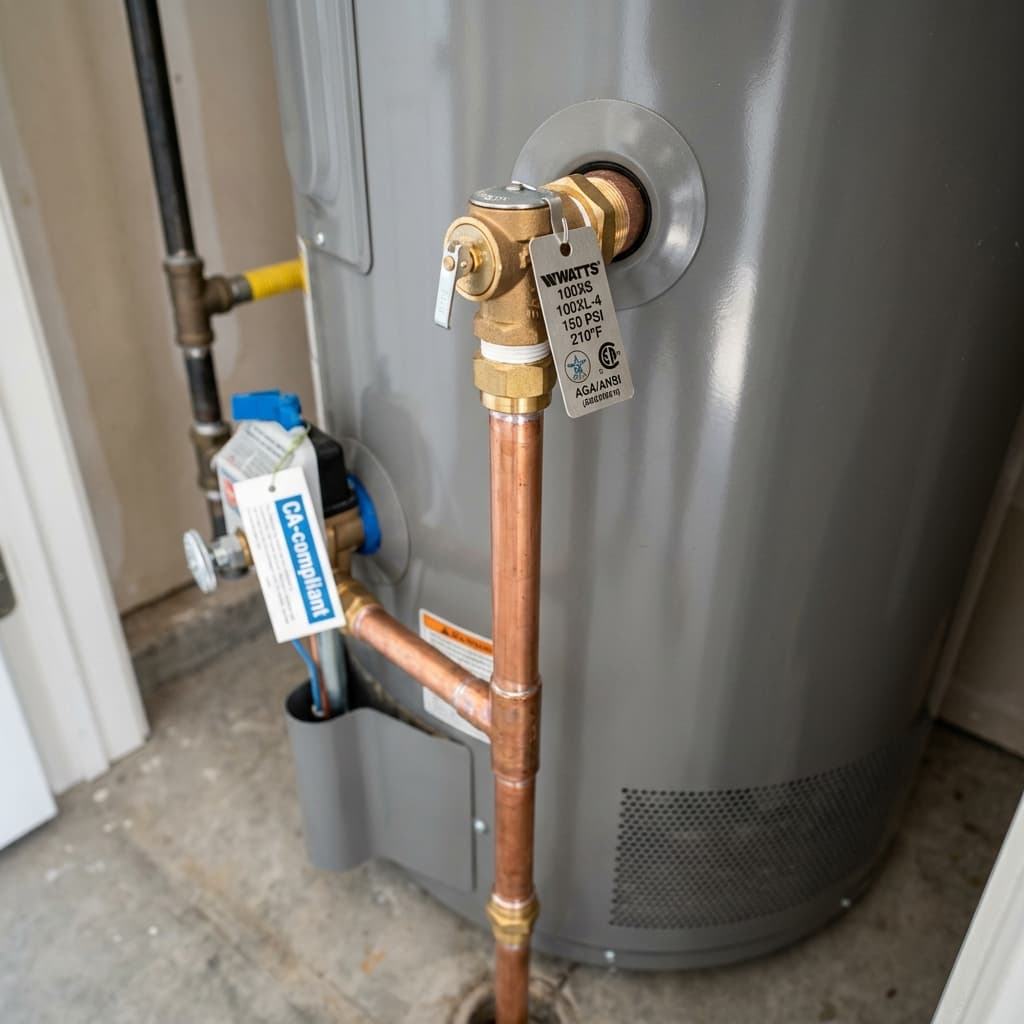
Temperature/Pressure Relief Valves (T/P valves) are critical safety devices required on all water heaters per CPC Section 422.50. These valves serve two functions:- Temperature Relief: Opens if water temperature exceeds 210°F
- Pressure Relief: Opens if tank pressure exceeds the relief valve's rated setting (typically 150 psi)
T/P Valve Sizing Requirements
This is where many exam candidates struggle. CPC Section 422.50 requires that T/P valve discharge capacity equal 150% of the water heater's BTU input rating. T/P Valve Sizing Formula: Required Discharge Capacity (GPH) = (BTU Input Rating ÷ 1,000) × 1.5Practical T/P Valve Sizing Examples
Example 1: Natural Gas Water Heater- Input rating: 40,000 BTU/hr
- Required discharge: (40,000 ÷ 1,000) × 1.5 = 60 GPH minimum
- Select T/P valve rated for 60 GPH or higher
- Input rating: 12,000 BTU/hr
- Required discharge: (12,000 ÷ 1,000) × 1.5 = 18 GPH minimum
- Select T/P valve rated for 18 GPH or higher
- Input rating: 180,000 BTU/hr (common for residential)
- Required discharge: (180,000 ÷ 1,000) × 1.5 = 270 GPH minimum
- Select appropriately rated T/P valve (often integral or tandem configuration)
T/P Valve Installation Standards
Per CPC Section 422.50, T/P valves must meet these installation requirements:
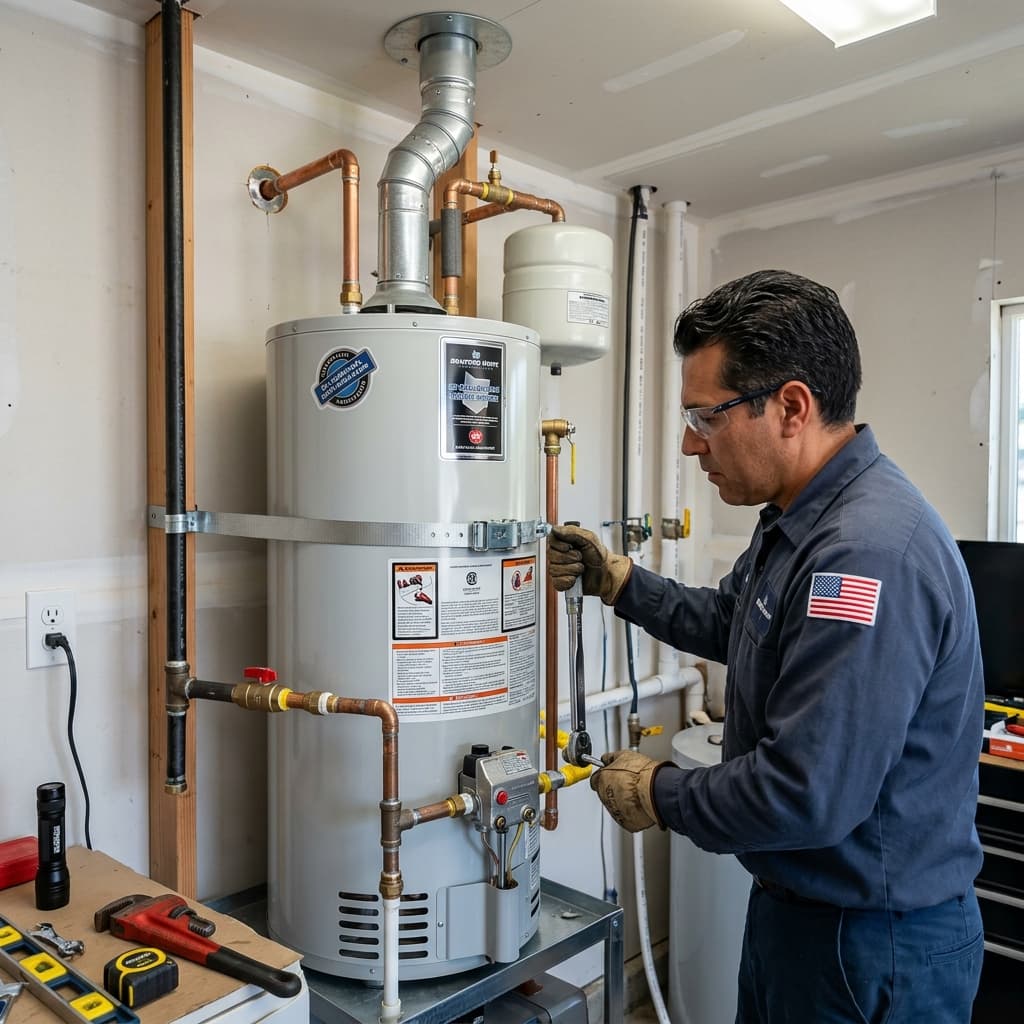
- Location: Installed within 6 inches of the water heater outlet connection
- Discharge Piping: Must be copper, brass, or stainless steel (not galvanized)
- Discharge Route: Must drain to a safe, visible location
- No Shut-offs: Cannot install shut-off valves in T/P discharge lines
- Elevation: Discharge line should slope downward (not required, but best practice)
- Accessibility: Must be easily accessible for inspection and maintenance
Expansion Tank Requirements
When water supply systems are metered or include check valves, water cannot return to the main supply line. This creates a closed system where heated water expands with nowhere to go—building dangerous pressure.
When Expansion Tanks Are Required
Per CPC Section 422.51, expansion tanks are mandatory when:- Water supply is metered or has a pressure reducer
- A check valve exists on the water supply line
- The municipal water system has a check valve
Expansion Tank Sizing
Expansion Tank Volume (gallons) = Water Heater Capacity × 0.04 × (Expansion Factor) For most applications, use this simplified approach:- 40-50 gallon heater: 2 gallon expansion tank
- 50-75 gallon heater: 5 gallon expansion tank
- 75-100 gallon heater: 8 gallon expansion tank
Common Water Heater Installation Mistakes (And How to Avoid Them)
Mistake 1: Undersizing T/P Valves
The Error: Installing a standard 3/4" T/P valve on all water heaters regardless of input rating. The Fix: Calculate required discharge capacity using the 150% formula and select appropriately rated valves. Many T/P valves are available in 3/4", 1", and larger sizes with different discharge ratings.Mistake 2: Installing Shut-Off Valves in Relief Lines
The Error: Adding a ball valve before the T/P valve for "maintenance purposes." The Fix: This is a code violation. T/P valves must have unobstructed discharge paths. Install shut-off valves only on the cold water inlet and hot water outlet lines.Mistake 3: Neglecting Expansion Tank Installation
The Error: Assuming expansion tanks are optional or only for large commercial systems. The Fix: Check for check valves or metered water supplies. When found, expansion tanks are mandatory per CPC Section 422.51.Mistake 4: Improper Discharge Line Routing
The Error: Discharging T/P valve output into drain lines without proper piping or discharging where it cannot be seen. The Fix: Route discharge lines visibly to the outdoors or a drain with proper slope and materials (copper, brass, or stainless steel only).Water Heater Installation Requirements California: Regional Considerations
Energy Commission Title 24 Compliance
California's Title 24 energy standards impose additional requirements beyond CPC Section 422:
- Minimum insulation R-values
- Pipe insulation requirements for hot water lines
- Efficiency ratings for tankless and storage systems
- Drain-back and freeze protection requirements for solar systems
Seismic Safety Bracing
California's seismic activity requires water heater bracing per CPC Section 310.1:
- Support straps placed within upper third and lower third of heater
- Bracing must accommodate expected movement
- All piping connections should include flexible connectors near the heater
Study Tips for C-36 Exam Success
Master these key formulas:- Peak Hour Demand = Total Fixture Units × 12.5
- T/P Valve Capacity = (BTU Input ÷ 1,000) × 1.5
- Expansion Tank Volume = Tank Capacity × 0.04
- No shut-off valves in T/P discharge lines
- T/P valve must be within 6 inches of heater outlet
- Discharge piping must be copper, brass, or stainless steel
- Expansion tanks required for closed water systems
- Calculate capacity for mixed residential/commercial buildings
- Size T/P valves for tankless systems with high input ratings
- Identify when expansion tanks are mandatory
- Recognize code violations in installation diagrams
Conclusion
Mastering water heater installation requirements California is essential for C-36 licensure and professional plumbing practice. By understanding CPC Section 422 requirements, applying proper sizing calculations, and correctly installing temperature and pressure relief valves, you'll ensure safe, code-compliant installations that protect both property and occupants.
Focus your exam preparation on the capacity calculation methodology and T/P valve sizing formulas—these topics appear consistently on the C-36 Part 2 examination. Review actual water heater specification sheets to understand how manufacturers list input ratings and factory-installed components, and practice installing expansion tanks on closed water systems.
With thorough knowledge of these standards, you'll confidently tackle the fixture requirements and water supply distribution questions on your C-36 exam while building a foundation for safe professional installations throughout your plumbing career.