

# Water Supply Line Sizing and Demand Load Calculations for C-36 Exam Success
Water supply line sizing and demand load calculations represent one of the most heavily tested topics on the California C-36 plumbing exam. This critical skill determines whether water distribution systems will deliver adequate flow and pressure to all fixtures while remaining economical. Understanding the methodology behind these calculations is essential for passing Part 2 of the exam and performing competent work in the field.
Understanding the Fundamentals of Demand Load Calculations
The demand load calculation process begins with understanding that not all fixtures operate simultaneously. A residential home with ten bathroom fixtures won't have all fixtures running at peak flow simultaneously. This principle—called diversity—allows plumbers to size smaller pipes economically while maintaining adequate service.
CPC Section 422 governs water supply and distribution in California, establishing the standards for calculating water demand loads. The section requires that water supply systems be sized to deliver the maximum demand load without pressure dropping below 20 psi at any fixture outlet.What Are Fixture Units?
Fixture units represent standardized measurements of water demand for plumbing fixtures. Rather than calculating actual gallons per minute (GPM) for each fixture type, the code uses fixture units as a universal measure. This standardization simplifies calculations across diverse fixture types.
CPC Section 422.1 establishes the fixture unit values for various plumbing fixtures:- Lavatory: 0.5 fixture units
- Water closet (tank): 1 fixture unit
- Water closet (flushometer): 3 fixture units
- Shower: 1 fixture unit
- Kitchen sink: 1.5 fixture units
- Bathtub: 1 fixture unit
- Bidet: 1 fixture unit
The Fixture Unit Demand Method
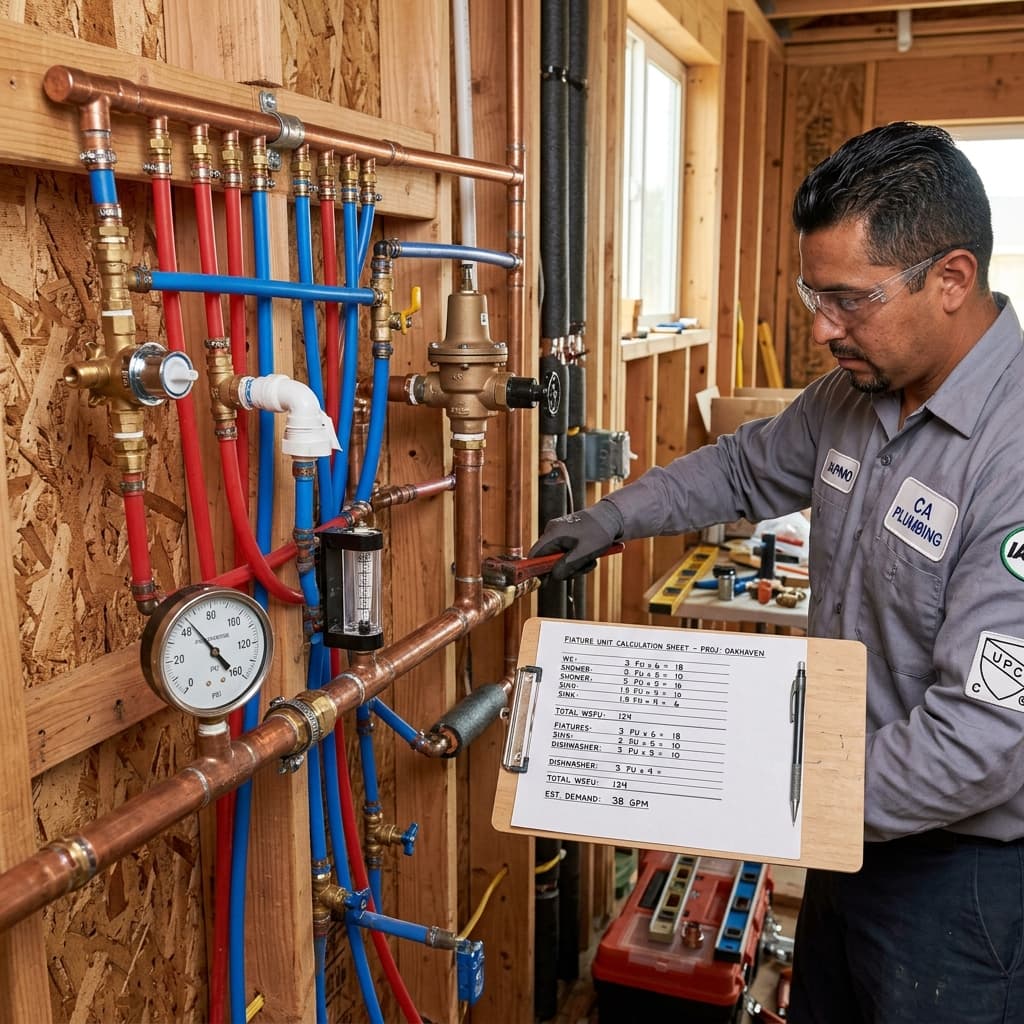
The fixture unit demand method forms the backbone of water supply sizing for the C-36 exam. This method involves four essential steps:
Step 1: Calculate Total Fixture Units
Begin by listing every water-using fixture in the building and assigning its corresponding fixture unit value. For example:
- One residential bathroom with 2 lavatories (0.5 × 2 = 1.0)
- One water closet (1.0)
- One bathtub (1.0)
- Total: 3.0 fixture units
- Hose bibs
- Washing machine connections
- Dishwashers
- Hot water heater connections
- Specialty fixtures
Step 2: Apply the Demand Percentage
CPC Section 422.2 requires applying demand percentages based on the fixture type and building occupancy. The code distinguishes between:- Residential buildings: Apply 100% of total fixture units for cold water and 100% for hot water
- Commercial buildings: Apply percentages based on fixture type and occupancy classification
- Multi-family buildings: Apply percentage factors based on the number of dwelling units
Step 3: Reference the Demand Load Table
Once you've calculated the demand fixture units, reference Table 422.1 in the CPC to determine the equivalent flow rate in gallons per minute (GPM). For example:- 3 fixture units = approximately 4.5 GPM
- 10 fixture units = approximately 8 GPM
- 20 fixture units = approximately 11.5 GPM
Step 4: Size the Supply Pipe
With demand load in GPM established, select pipe sizing from Table 422.2 based on:- Available supply pressure
- Length of supply run
- Pipe material
- Desired flow velocity (typically 5-8 feet per second maximum)
Pressure Requirements and Supply Conditions
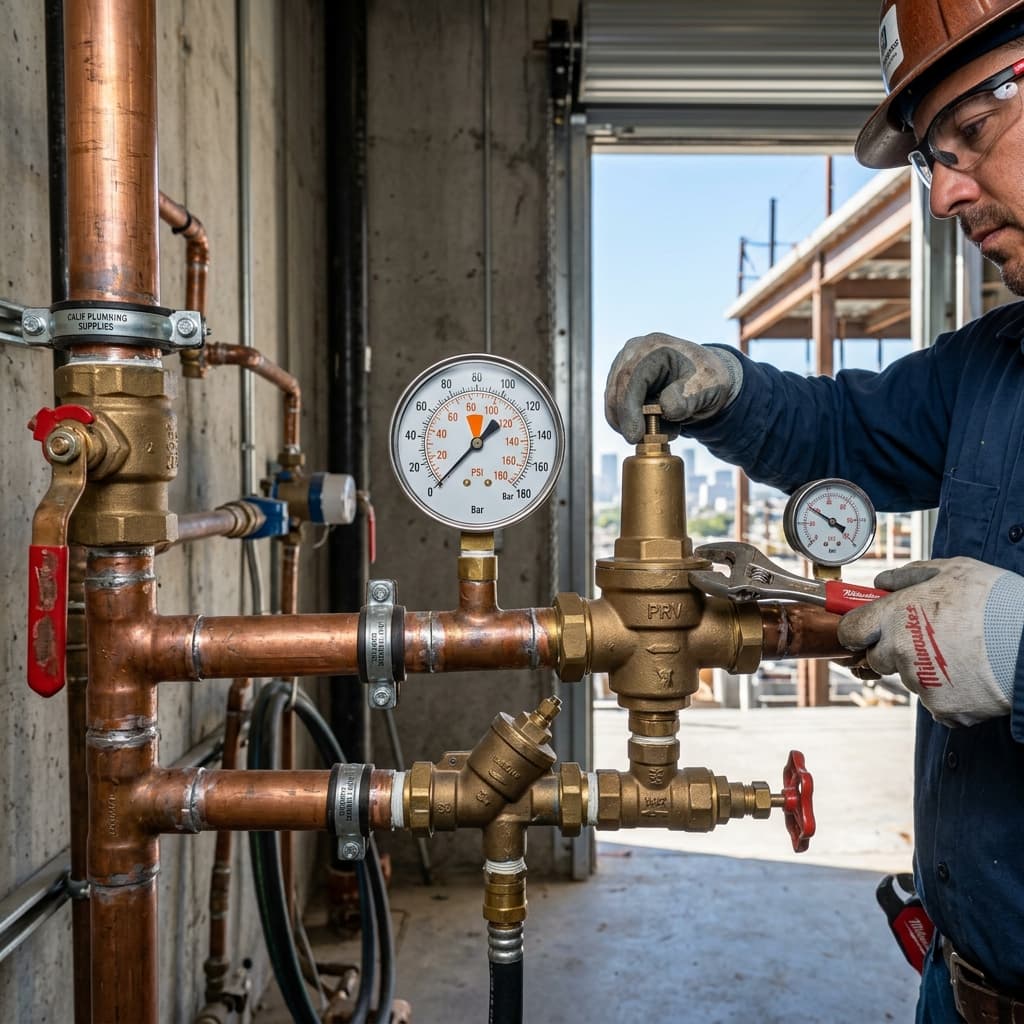
Water supply systems must maintain minimum pressure standards established by CPC Section 422.3. Understanding these requirements is crucial for exam success.Minimum Pressure Standards
- Minimum pressure at fixture outlets: 20 psi (residential)
- Maximum pressure at fixture outlets: 80 psi
- Recommended design pressure: 60-70 psi (maintains pressure drop allowances)
Pressure Loss Calculations
Pressure loss occurs through:- Friction losses - resistance as water moves through pipes
- Static pressure losses - elevation changes (0.433 psi per foot of elevation)
- Meter losses - water meter resistance (typically 5-15 psi)
Common C-36 Exam Scenarios and Solutions
Scenario 1: Single-Family Residence Sizing
Problem: Size the main water supply line for a 4-bedroom home with:- 3 full bathrooms (each with lavatory, water closet, and bathtub)
- 1 half bathroom (lavatory and water closet)
- Kitchen with sink and dishwasher
- Laundry room with washer
- 2 exterior hose bibs
- Supply pressure available: 65 psi
- Calculate fixture units:
- Apply demand percentage (100% for residential): 13.0 fixture units
- Reference Table 422.1: 13 fixture units = approximately 9.5 GPM
- Use Table 422.2 with 65 psi available and 9.5 GPM demand: ¾-inch copper (or equivalent)
Scenario 2: Multi-Story Building with Pressure Regulation
Problem: A 3-story apartment building requires water supply sizing considering:- Ground floor: 8 fixture units (common area restrooms)
- Second floor: 12 fixture units (apartment)
- Third floor: 12 fixture units (apartment)
- Static pressure loss from elevation: 1.3 psi per floor
- Available supply pressure: 60 psi
For multi-story buildings, calculate demand at the highest floor where pressure will be lowest:
- Highest floor demand: 12 fixture units = 8 GPM
- Available pressure at third floor: 60 psi - (2 × 1.3) = 57.4 psi
- Considering meter loss (10 psi) and friction losses, design pressure: 47.4 psi
- Reference Table 422.2: Select pipe size maintaining adequate pressure
Hot Water Supply Demand Calculations
Hot water supply sizing follows the same fundamental process but with important distinctions:
CPC Section 422.4 requires sizing hot water systems based on:- 100% of hot water fixture unit demand (same calculation as cold water)
- Reduced demand percentages for multi-family buildings
- Consideration of hot water heater capacity
- Most fixtures demand both hot and cold water simultaneously
- Water heaters must support peak hot water demand
- Distribution piping from heater to fixtures follows same sizing tables as cold water supply
Hot Water Example:
In our single-family residence example (13 total fixture units):- Fixtures using hot water: lavatories (2.0), bathtubs (3.0), kitchen sink (1.5), dishwasher (0.5), washer (1.0)
- Total hot water fixture units: 8.0
- From Table 422.1: 8 fixture units = approximately 6 GPM hot water demand
Advanced Exam Topics: Meter Sizing and Backflow Prevention
Water Meter Selection
Water meters create friction losses that reduce available pressure for the distribution system. CPC Section 422.7 establishes requirements for meter selection. Meter sizes are selected based on:- Maximum demand flow rate (GPM)
- Acceptable pressure loss through meter (typically 10-15 psi at maximum flow)
- Service size requirements
Backflow Prevention Devices
Backflow prevention requirements affect available system pressure:
- Reduced Pressure (RP) devices: Loss of 10-15 psi
- Double Check Valve (DCV) devices: Loss of 5-10 psi
- Atmospheric Vacuum Breakers (AVB): Minimal loss
Test-Taking Strategies for Demand Load Questions
Strategy 1: Use Process of Elimination
Demand load questions often include obviously incorrect answers. If the calculated demand is 10 GPM, answers suggesting 25+ GPM or 2 GPM are likely wrong. Eliminate these immediately.
Strategy 2: Verify Your Fixture Unit Addition
The most common error in demand calculations is arithmetic—miscounting fixture units or adding them incorrectly. Double-check your fixture unit totals before referencing tables.
Strategy 3: Watch for Trap Answers
The exam frequently includes the demand assuming 100% simultaneous use (pre-table calculation) as an answer choice. Remember that Table 422.1 already accounts for diversity—using pre-table values is incorrect.
Strategy 4: Consider System Context
Some questions test your understanding of how demand relates to other system components:- "What size water heater is required?" (demand flow × desired temperature rise)
- "What meter size is needed?" (demand flow + 15% safety margin)
- "What pressure drop is acceptable?" (supply pressure - 20 psi minimum)
Summary: Key Points for Exam Success
Master these fundamental concepts for confident test performance:
- Fixture units are standardized measures of water demand, not actual GPM
- Table 422.1 is your essential reference for converting fixture units to GPM demand
- Diversity factors are built into the code tables—don't apply additional demand percentages to residential single-family homes
- Pressure requirements drive sizing decisions—understand the relationship between available pressure, demand, and pipe size
- Multi-story buildings require special consideration for static pressure losses and upper-floor pressure maintenance