

# Mastering Drainage System Design: Trap Sizing, Venting Requirements, and CPC Code Compliance for C-36 Exam Success
When preparing for the California C-36 plumbing exam, understanding california plumbing code drainage systems is absolutely critical. Part 3 of the exam focuses extensively on drainage and venting systems, making this content area one of the most heavily tested sections. Whether you're calculating drain trap sizing requirements or determining appropriate plumbing vent stack sizing, this comprehensive guide will walk you through everything you need to master drainage system design according to the California Plumbing Code (CPC).Why Drainage and Venting Systems Matter for the C-36 Exam
The drainage system is the backbone of any plumbing installation. It safely transports wastewater away from fixtures while maintaining proper sanitation and preventing sewer gas from entering occupied spaces. The C-36 exam expects you to understand not just the "what" but the "why" behind every requirement.
Part 3 of the C-36 exam typically accounts for 25-30% of total test questions, with drainage and venting systems comprising a significant portion of those questions. You'll need to apply CPC standards to real-world scenarios, calculate proper sizing, and identify code violations in design plans.
Understanding Trap Fundamentals and CPC Section 308
What is a Trap and Why Do We Need Them?
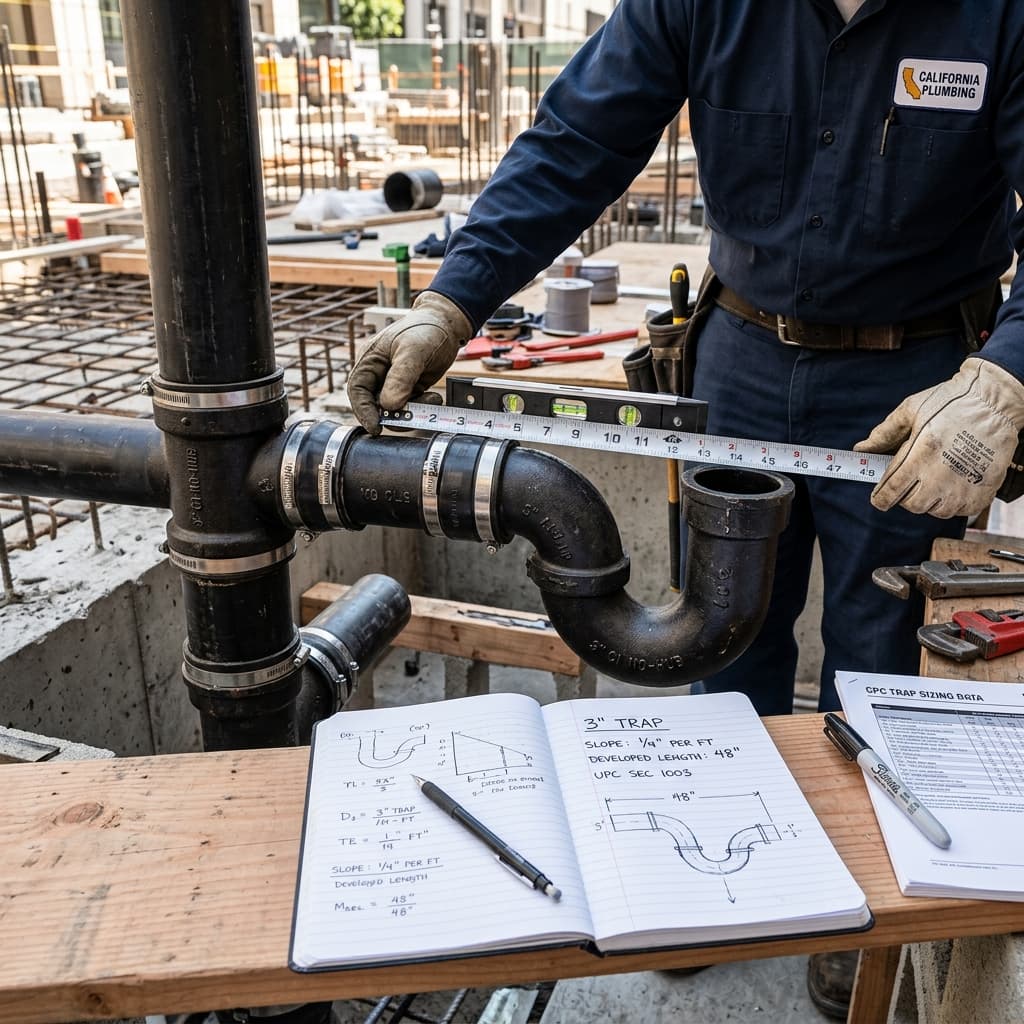
A trap is a U-shaped or S-shaped section of pipe that maintains a water seal, typically 2-4 inches deep. This water seal prevents sewer gases from entering the building while allowing wastewater to flow freely.
CPC Section 308.1 defines a trap as "a bend, curve, or dip in the drainage piping that creates a water seal to prevent the passage of gases, but without materially affecting the flow of the drainage system."Every fixture that discharges waste must be equipped with a trap. The key requirements per CPC Section 308 include:
- Every fixture must have an individual trap except for certain grouped fixtures
- Traps must be accessible for cleaning and maintenance
- The water seal must be maintained at all times during normal operation
- Proper pitch and alignment prevent trap seal loss
Common Trap Configurations
Understanding different trap types is essential for your exam:
P-Trap: The most common configuration, shaped like the letter P. Used for sinks, showers, and most indoor fixtures. S-Trap: Prohibited in California under most circumstances due to seal loss risk. You'll likely see this on the exam as a violation identification question. Drum Trap: Used in certain commercial applications for grease removal. Must maintain proper water seal and ventilation. Bell Trap: Less common but sometimes encountered in older installations. Must be equipped with proper venting.Drain Trap Sizing Requirements: The Critical Calculations
Determining Proper Trap Size
CPC Section 308.2 establishes that trap size must match the fixture drainage connection. Here are the standard requirements:| Fixture Type | Minimum Trap Size | Notes | |---|---|---| | Lavatory | 1.25" | Cannot be larger than 1.5" | | Kitchen Sink | 1.5" | May be 2" for commercial | | Shower/Tub | 2" | Minimum requirement | | Floor Drain | 2" | Standard minimum | | Water Closet | 3" | Non-negotiable standard | | Laundry Tub | 1.5" | May be 2" for commercial |
The trap size must never be smaller than the drainage outlet of the fixture it serves. This is one of the most frequently tested requirements on the C-36 exam.
Trap Seal Depth Calculations
CPC Section 308.3 specifies that trap seals must maintain a minimum depth of 2 inches and maximum depth of 4 inches. This is a critical calculation point: Seal Depth Formula:- Minimum = 2 inches
- Maximum = 4 inches
- Optimal = 3 inches
On the C-36 exam, you might encounter questions like: "A floor drain has been installed with a trap seal of 5.5 inches. What code violation has occurred?" Answer: Exceeds maximum trap seal depth per CPC Section 308.3.
Plumbing Vent Stack Sizing: The Essential Guide
Understanding Vent System Purposes
Before calculating vent stack sizes, you need to understand why venting is critical. Proper venting:
- Maintains fixture drain performance by allowing air to enter the system
- Prevents siphonage of trap seals
- Allows gases to escape safely to the exterior atmosphere
- Enables proper drainage velocities (typically 2-6 feet per second)
CPC Section 309: Vent System Requirements
CPC Section 309.1 establishes the foundational vent requirements. Key provisions include:- Every trap must be vented
- Vent systems must be sized according to drainage load calculations
- Vents must terminate above the roof, minimum 12 inches above any opening
- Vent stacks cannot be used as soil stacks
Plumbing Vent Stack Sizing Calculations
This is where CPC drainage calculations become practical. Vent stack sizing depends on:- Drainage Fixture Unit (DFU) Load: Sum of all fixtures connected
- Stack Height: Vertical distance from lowest branch to roof
- Type of Configuration: Wet venting, back venting, or full venting
| DFU Load | Vent Stack Size (Horizontal/Vertical) | |---|---| | 1-500 | 1.5" minimum | | 501-1000 | 2" minimum | | 1001-1500 | 2.5" minimum | | 1501-2000 | 3" minimum | | 2001+ | 4"+ (consult CPC Table 309.2) |
Practical Example for the Exam: You're designing a residential building with the following fixtures:- 8 lavatories (1 DFU each) = 8 DFU
- 4 water closets (3 DFU each) = 12 DFU
- 4 kitchen sinks (2 DFU each) = 8 DFU
- Total DFU Load = 28 DFU
- Stack Height = 40 feet
On the C-36 exam, you'll need to perform these calculations quickly and accurately.
Horizontal and Vertical Vent Configurations
Understanding Vent Stack Types
Soil Stack Venting (Full Venting): The most common configuration where a single stack carries both discharge and vent functions. Per CPC Section 309.3, this is the standard approach. Wet Venting (Combination Waste and Vent): Permitted under specific conditions per CPC Section 309.4. Key restrictions:- Limited to specific fixtures (sinks, lavatories, showers)
- Water closets cannot be wet vented
- Requires specific pipe sizing and pitch
Critical Pitch Requirements
Horizontal vent runs must maintain proper pitch:- Minimum pitch: 1/4 inch per foot (per CPC Section 307.2)
- Maximum pitch: 45 degrees from horizontal
- No sagging or dips are permitted in vent lines
Common Drainage System Violations You'll See on the Exam
Trap-Related Violations
Double Trap Situation: Two traps serving one fixture. Prohibited per CPC Section 308.4. Answer: Creates unnecessary turbulence and maintenance issues. Crown Vent Installation: The vent connects above the trap's weir. This violates CPC Section 309.5 and allows siphonage. S-Trap Usage: Still seen in older homes. This violates current CPC standards.Vent-Related Violations
Undersized Vent Stack: A 2-DFU load on a 1" vent violates Table 309.2 requirements. Vent Termination Issues: Vents terminating under an eave, near a window, or less than 12 inches above roof violate CPC Section 309.2. Improper Pitch on Horizontal Vents: Less than 1/4" per foot violates CPC Section 307.2.CPC Drainage Calculations: Step-by-Step Methodology
The Five-Step Calculation Process
Step 1: Identify All Fixtures List every fixture that will connect to the drainage system with its DFU value. Step 2: Calculate Total DFU Load Sum all individual fixture DFU values. Step 3: Determine Stack Configuration Decide if you'll use full venting, wet venting, or individual venting based on layout and code restrictions. Step 4: Consult CPC Tables Reference Table 309.2 for vent sizing based on DFU load and stack height. Step 5: Verify All Requirements Confirm proper pitch, clearances, termination, and connections per CPC Sections 307-309.Real Exam Scenario
Question: A commercial building requires drainage design. Ground floor has 12 water closets, 15 lavatories, and 8 kitchen sinks. Second floor has 8 water closets, 10 lavatories, and 4 kitchen sinks. The vent stack height is 35 feet. What is the minimum required vent stack size? Solution:- Ground floor WC: 12 × 3 = 36 DFU
- Ground floor lavatories: 15 × 1 = 15 DFU
- Ground floor sinks: 8 × 2 = 16 DFU
- Second floor WC: 8 × 3 = 24 DFU
- Second floor lavatories: 10 × 1 = 10 DFU
- Second floor sinks: 4 × 2 = 8 DFU
- Total: 109 DFU
Mastering Trap Seal Protection
Siphonage and How to Prevent It
Trap seal loss through siphonage is one of the most frequently tested topics. Siphonage occurs when:- Excessive velocity in the drainage line creates a vacuum
- Improper venting allows pressure differences
- Undersized or oversized traps create turbulence
- Proper sizing of all drainage and vent components
- Correct pitch on all runs (1/4" to 1/2" per foot)
- Adequate venting per Table 309.2
- Proper terminal vent sizing
Anti-Siphon Devices
While mechanical anti-siphon devices exist, CPC Section 309.1 establishes that proper system design—not mechanical devices—is the preferred method. You should be able to design systems that don't require anti-siphon devices.Final Preparation Tips for C-36 Exam Success
Study Strategy for Part 3
- Master the DFU concept: This is the foundation of all drainage calculations
- Memorize key tables: CPC Tables 309.1 and 309.2 appear frequently
- Practice calculations: Work at least 10 multi-fixture drainage problems
- Study violation scenarios: The exam loves showing improper installations
- Review pitch requirements: Multiple questions test your knowledge of proper slopes
Common Exam Question Patterns
- "What is the minimum/maximum trap seal depth?" (Answer from CPC 308.3)
- "Calculate the vent stack size for X fixtures" (Answer using Table 309.2)
- "Identify the code violation in this drawing" (Look for undersized traps, improper pitch, crown vents)
- "What is the DFU load for this fixture list?" (Arithmetic + memorized values)
Time Management on Test Day
Drainage questions often require calculations. Budget approximately 1-2 minutes per question, allowing extra time for complex scenarios.
Conclusion
Mastering california plumbing code drainage systems, drain trap sizing requirements, and plumbing vent stack sizing is essential for C-36 exam success. By understanding the principles behind CPC drainage calculations and applying them systematically, you'll be prepared for the diverse question formats covering Part 3: Drainage and Venting Systems.Remember: The code exists to protect public health and ensure proper system function. When you understand the "why" behind each requirement—not just the "what"—you'll excel on the exam and become a more effective plumbing professional.
Review Water Distribution Systems and Sizing Requirements to understand how supply systems connect to drainage systems, or Fixture Connections and Rough-In Standards for specific fixture installation details.---